Risk & Performance
Know what your loans are worth, and how they would hold up when conditions turn.
Risk & Performance turns the data in your book into valuations you can defend. It calculates IFRS 9 expected credit loss and DCF fair value for every facility, tracks gross performance, runs stress tests and validates the models behind them, while keeping the credit model open to everyone and changeable only through governed calibration.
For risk teams, valuation committees and portfolio managers
Key capabilities
Valuation
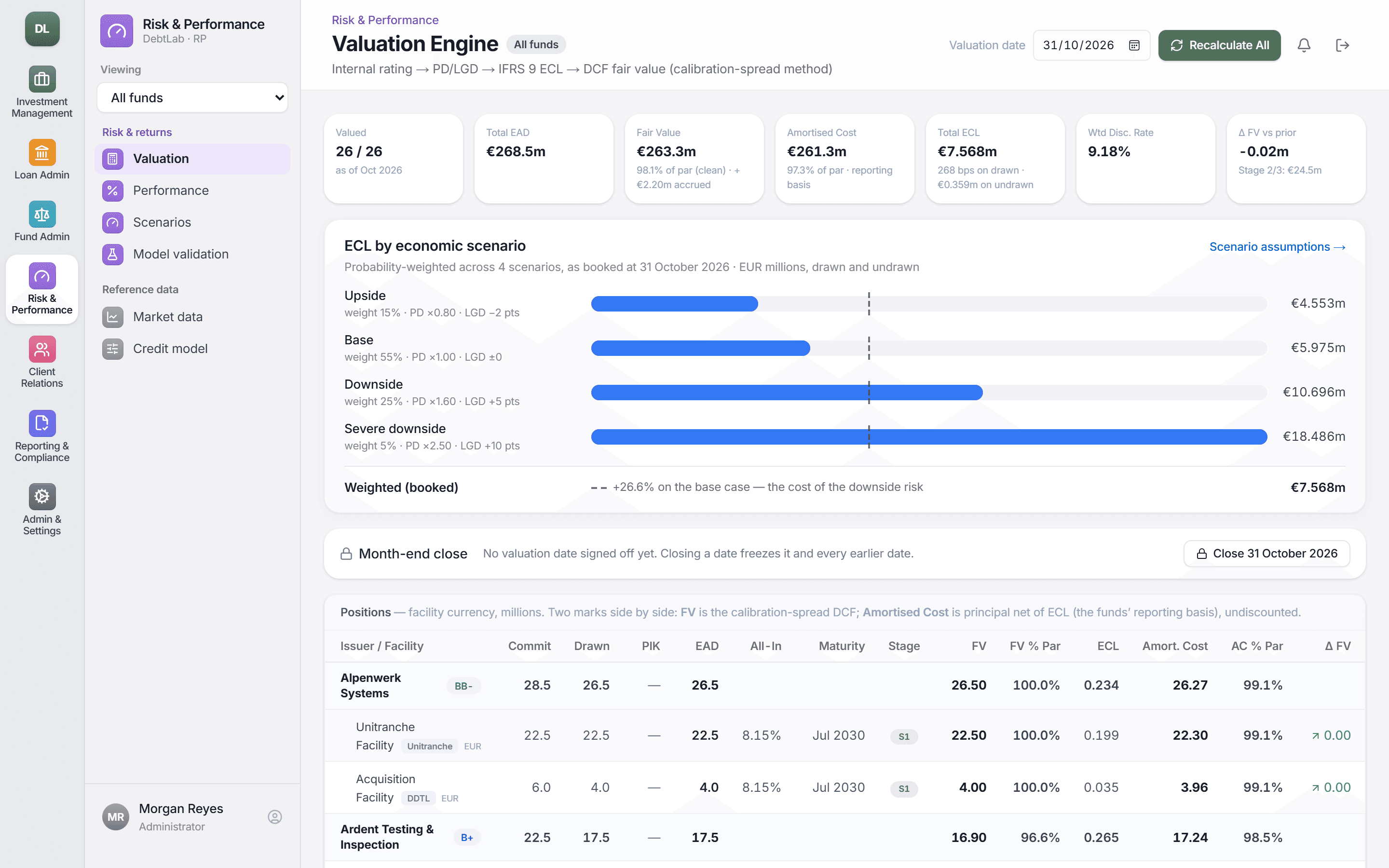
Follow a clear line from internal rating to PD and LGD, then on to IFRS 9 ECL and a DCF fair value using the calibration-spread method, with amortised cost shown alongside. Accrued interest is included in NAV, and floating coupons use captured fixings before moving on to forward rates.
ECL by economic scenario
Weight ECL across upside, base, downside and severe-downside scenarios, each of which scales PD and shifts LGD in its own way, with ECL on undrawn commitments reported separately.
Month-end close
Once a valuation date has been reviewed, close it and it stays closed, along with every date before it. The quarterly NAV in Fund Admin waits for that closed valuation, so the numbers your investors see always rest on a settled run.
Performance
Gross IRR, money multiple and cash yield for every facility, every borrower and the portfolio as a whole, measured both to date and to maturity.
Stress testing
Ask the questions your committee will ask. Shock EBITDA, base rates and credit spreads, and see straight away what happens to covenants, ratings, ECL and value, across the whole book or a single fund.
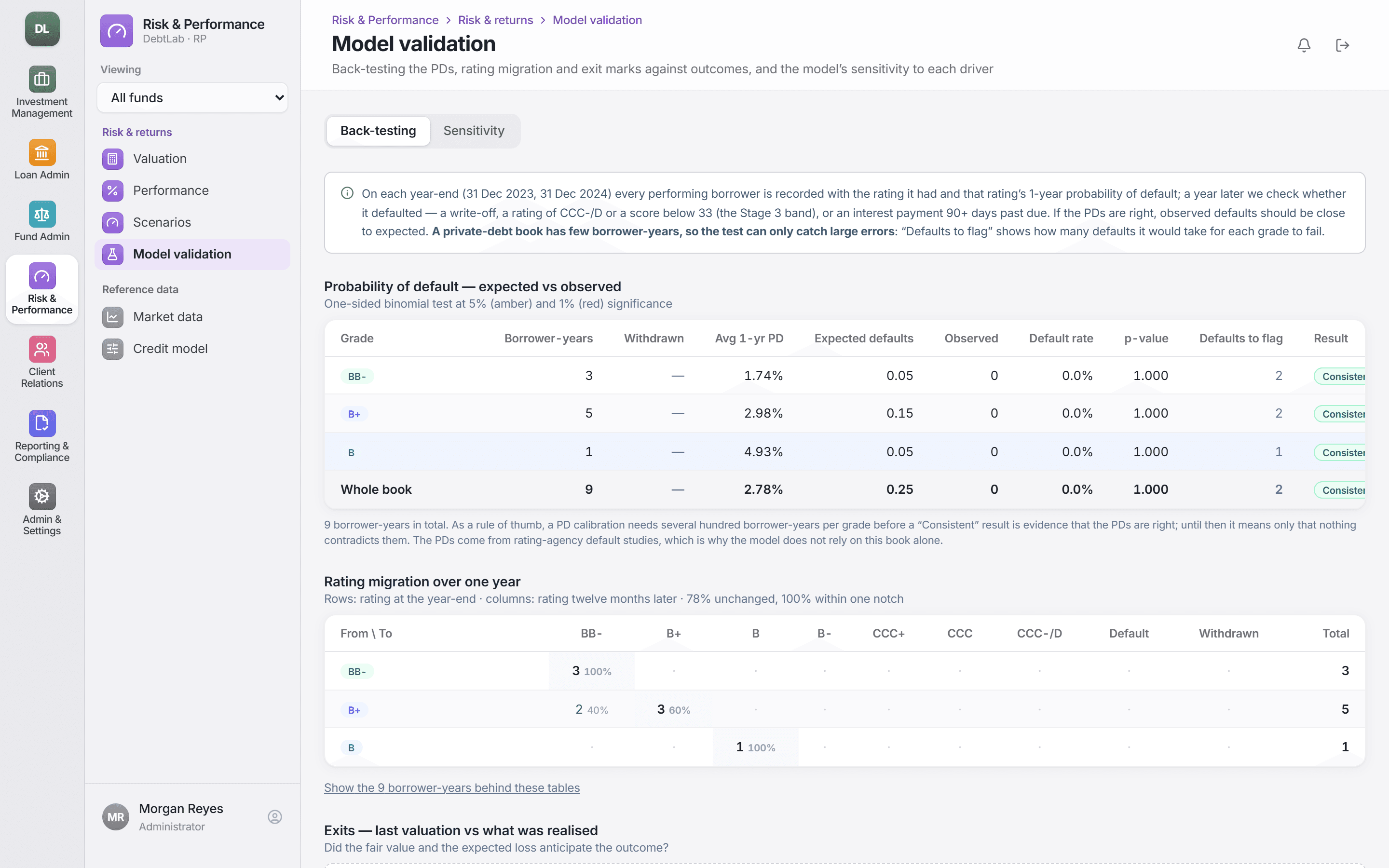
Model validation
Back-test PDs on annual cohorts with a binomial test, study the rating migration matrix, compare exits with their last mark, run one-at-a-time sensitivities and see exactly how much EBITDA headroom each borrower has before a downgrade.
Credit model and market data
Nothing about the model is hidden. The rating scorecard, PD and LGD tables and staging rules are open to every user, any change shows its effect on each borrower before it is applied, and every change can be rolled back. Swap curves, margins and FX rates are kept by date.
Controls built in
- Closed valuation dates can only be reopened by an administrator, with the reason recorded
- Every model change is logged with before-and-after values and can be rolled back
- A written model methodology explains each calculation and its limitations
Walkthrough
From deal to valuation
Watch a deal travel through the pipeline and close into a borrower file. From there, monthly financials feed the tear sheet, the internal rating and the covenant tests, and the valuation turns it all into IFRS 9 ECL and a DCF fair value.
See how DebtLab would work for your fund
Book a live walkthrough of our demo fund, tailored to the way your team runs deals, operations and investor reporting today, and bring your toughest questions with you.